
Use Your Men's Fragrance Brief as a Supplier Test: What the Answers Reveal
The cheapest supplier evaluation available to a fragrance brand is the brief itself. Send the same well-specified brief to three factories and compare the responses, not the totals: what each one asks for, what each one assumes without asking, and what each one warns you about. A response that interrogates the brief is worth more than a response that prices it immediately. The pattern that emerges in an hour of reading tells you more about the coming twelve months of your men's line than a certificate list will.
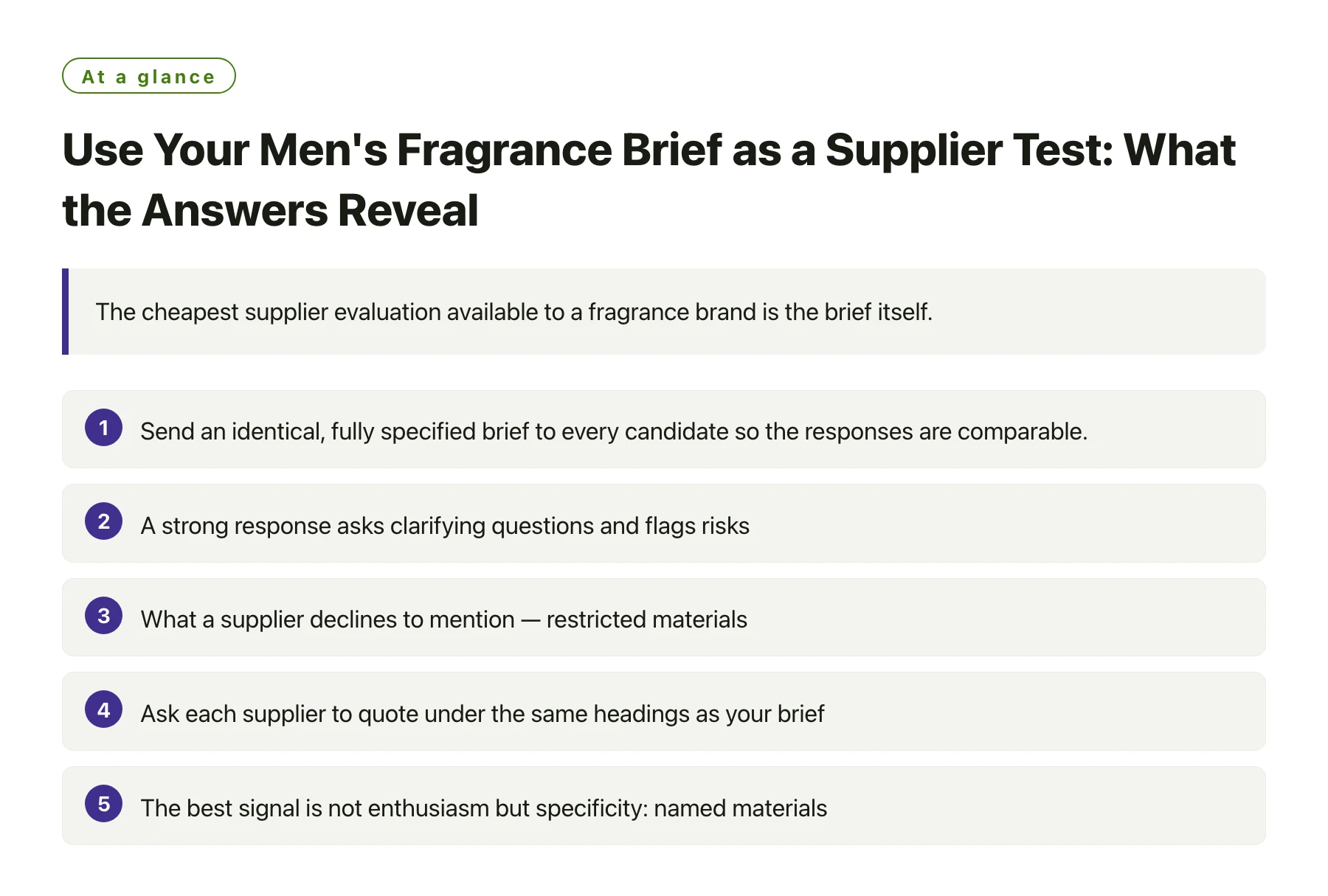
Key takeawaysSend an identical, fully specified brief to every candidate so the responses are comparable. · A strong response asks clarifying questions and flags risks; a weak one quotes a total price and waits for the order. · What a supplier declines to mention — restricted materials, testing scope, documentation duties — predicts where your project will stall. · Ask each supplier to quote under the same headings as your brief, then compare line by line rather than in total. · The best signal is not enthusiasm but specificity: named materials, named tests and named documents.
Most supplier comparisons fail for a procedural reason rather than a judgement one. Each factory receives a slightly different version of the brief, or answers in its own format, and the brand ends up comparing totals that describe different scopes.
Standardising the brief and the quotation format fixes that. What remains is to read the responses for the signals that matter, which are usually found in what the supplier raises unprompted.
Six questions, and what the answers tell you
| What you ask or send | Weak answer | Strong answer | What it reveals |
|---|---|---|---|
| Which materials in the direction carry restrictions | That the formula will comply when it is built | Which components use most of their allowance, and in which product category the limits apply | Whether the team works to the published industry standards or only to a house habit |
| Which tests you should expect | That testing is included | A named list of stability, compatibility and microbiological checks, with the option of an independent report | Whether the internal controls are defined or improvised |
| Who owns the formula and the artwork | That this can be discussed later | A clear position on formula use, exclusivity scope and tooling ownership, in writing | Whether the commercial model is settled or improvised |
| What the destination market requires | That the factory ships there regularly | Which market-specific duties apply and what documentation the customer has to hold | Whether the export experience is real or a brochure line |
| What happens if a batch does not match the reference | That this does not happen | How a deviation is recorded, who approves it and what the remedy is | Whether quality is a system or a promise |
| How a repeat order is produced | That it is straightforward | How the formula and the retained reference are stored, and how components are re-sourced | Whether continuity is designed in from the first run |
The pattern is more informative than any single row. A supplier that answers four of the six specifically, and asks two follow-up questions of its own, is behaving like a manufacturer. A supplier that answers none of them and offers a discount is behaving like a broker.
Why the brief is a better test than a questionnaire
A questionnaire asks a supplier to describe itself. A brief asks it to think about your product, which is the work you are actually buying. The response to a brief cannot be assembled from a template, because it has to engage with your format, your market and your price.
It also produces comparable information. When three factories receive the same brief and are asked to answer under the same headings, the differences between them become visible immediately.
Restriction status separates the two kinds of supplier
Fragrance materials are restricted individually and per product category, and the published standards library sets the levels most suppliers work to [1]. A supplier that can name which components in the proposed direction carry the tightest limits is reading the brief properly. One that promises compliance without naming anything is asking you to take the risk on trust.
Testing scope exposes the difference between a lab and a line
Independent laboratories publish the scope of the cosmetic and personal care testing they perform, which makes it possible to state precisely what an external report would and would not cover [2]. A factory that distinguishes its internal checks from an outside report is being accurate. A factory that treats the two as interchangeable is either unfamiliar with the difference or hoping you are.
Ownership answers should be written, not implied
A formula, a brand name and a bottle design are different kinds of right, with different registration routes and different durations, which is why ownership of a fragrance project cannot be resolved with a single sentence about who owns the scent [3]. Ask for the position in writing before the first order; a supplier that has thought about it will answer in two paragraphs, and one that has not will suggest leaving it until later.
Market-specific rules are the second half of the same question. The EU, for example, regulates particular cosmetic topics separately, from animal testing to nanomaterial reporting, and a supplier that can explain which of them touch your product is tracking the rules rather than recalling them [4].
Turning the responses into a shortlist
Score the responses against the same criteria the responses themselves were asked to meet: specificity, willingness to raise problems, and clarity about who carries which risk. Then shortlist two, not five.
A final step is worth the effort. Ask each shortlisted supplier for one more thing — a batch record from a comparable product, or a short call with the person who would actually run your project. A decision made on those two conversations is usually the right one, and it takes less time than the third round of negotiation that follows a bad choice.
Read the questions they ask you
The quality of a supplier's questions predicts the quality of the project. Factories that ask about the occasion of wear, the climate, the pack and the target price are building a cost model. Factories that ask only about volume are building an invoice.
It is reasonable to expect a development partner to push back on at least one line of the brief. A response with no reservations at all usually means the brief was not read closely. When a manufacturer's own description of its scope is detailed enough to compare against your brief line by line, as with an established Xuelei fragrance house, the comparison is easier to make — and the reservations, when they come, are easier to evaluate.
Whatever the outcome, keep the losing responses. A supplier that answered well but was wrong for this project is a candidate for the next one, and the file is worth keeping for the checks that what to verify before signing with a fragrance manufacturer lays out.
One caution about the test: do not write a brief that is impossible on purpose. A supplier that spots an artificial trap and says so is being helpful, but a buyer who tests suppliers with trick questions tends to attract suppliers who are good at answering questions rather than good at making product. The brief should be demanding because the project is demanding, not because the buyer is.
Sources
- IFRA Standards Library (International Fragrance Association) —— The IFRA Standards Library lists the restrictions the fragrance industry applies to individual fragrance ingredients, based on safety assessments; it is the reference point for compliant fragrance formulation.
- SGS: Cosmetics, Personal Care & Household Testing —— Testing, inspection and certification services for cosmetics and personal care, including microbiological, stability and safety testing aligned with cosmetics GMP.
- WIPO — World Intellectual Property Organization —— The UN agency for intellectual property; resources on industrial design and patent protection relevant to product and packaging design.
- European Commission: Cosmetic Products — Specific Topics —— EU pages covering specific cosmetics topics such as product claims, nanomaterials and animal-testing rules.
Frequently asked questions
How many suppliers should I send the brief to?
Three is usually the right number: enough to see a pattern, few enough that each response can be read properly. Sending it to eight suppliers produces a spreadsheet of totals rather than a comparison of capabilities.
What if a supplier will not answer questions before receiving an order?
Some will not disclose restriction details or testing scope before a confidentiality agreement is signed, which is reasonable. A refusal to discuss process at all is a different matter, and it means the information you need will not be available later either.
Should the brief include my target price?
Yes, as a target and a ceiling. Without it the supplier cannot tell you whether the direction is achievable in your pack, and the answer will arrive as a quotation you cannot use.
Do certificates replace this kind of evaluation?
No. A certificate describes a management system, not the batch you will receive or the way a specific project will be run. It is a useful filter, and the brief response is what tells you how the two of you will work together.
How long should I allow for the comparison?
Two to three weeks is typical for three responses, including a short call with each. Rushing this stage is what produces the expensive correction later, because changing supplier after sampling means paying for the same development twice.
Ready to play?
Skip the read — jump straight into thousands of free browser games. No downloads, no sign-ups.
Play Now — It's Free